
THE THREE GUYANAS
- rouletout608
- May 10
- 9 min read
We didn’t really know what to expect of the three Guyanas, French Guyana, Suriname and Guyana that are nested on the northeastern corner of South America. We had never met anyone who travelled there and they are definitely not big on the tourist map. The plan was to make use of the short drier season nested between the major wet seasons - typically lasting from January to April - and to re-enter Brazil from Guyana before the infamous road linking Georgetown and Lethem turns into an impassable mud bath.
That being said, French Guyana welcomed us with torrential rain. The new bridge over the Oyapok river brought us to the border of France (French Guyana is an overseas department and full part of France and thus the European Union) and it felt kind of weird to enter Europe with our truck after all those years. Following an easy border crossing without any temporary import formalities or stamps in our passports, the only hold ups were that the lady checking the passports was - as Berna - also born in Silifke and thus got very excited and that we had to get (overpriced) European insurance, we continued a few kilometres before finding a spot for the night not far from the road. The rain didn’t stop.


A well maintained but winding road without much traffic carried us through dense rain forest towards Cayenne, the capital of French Guyana. The only signs of civilisation were plenty of road signs (well, we were back in Europe) and every few kilometres a completely burnt out car wreck, many of them already with trees growing out of them.
The rain continued when we arrived in Cayenne where we found a decent spot on the beach just outside of town and not far from Thibault and Anne’s house, our friends whom we met kiting in Brazil. Thibault was so kind to receive a package for us from Europe and he also had provided us with all the info to finally organise new tires for our truck, a headache we carried now for a while with us. We enjoyed an amazing dinner with local specialties at Thibault and Anne’s place exchanging travel stories till late, not even finding the time to take a picture. Thibaut also provided an explanation for all the burnt out wrecks you see all over French Guyana: gangs from Brasil, often involved in illegal gold mining and / or drug trafficking, scavenge the cars for parts and when done, just leave them next to the road. Illegal gold mining (across all of the Guyanas) is also a major contributor to environmental pollution and destruction of natural habitats. With that in mind, our five new tires, plenty of French cheese, salami, duck liver and French baguette we left Cayenne. We must admit, it is a pleasure to visit a Carrefour after all those years.


One commonality between the Guyanas is, that there is essentially just one road, more or less along the coast. As we followed this road north west we reached the European space port in Kourou. With a scheduled lift-off in a few weeks the tours were already stopped (one wonders what preparations take weeks for a space launch nowadays, but well obviously Europe is not up to SpaceX’s cadence) but we visited the exhibition that seems mostly targeted at school kids.
Kourou has also a nice kite sport, unfortunately there was no wind so we continued towards the border with Suriname. But first we visited the second village of Hmong refugees from Laos in French Guyana, Javouhey. It was market day and we were able to taste Laotian food and had kind of a small flash back to our time in Laos. From Javouhey it was just a few kilometres to Saint-Laurent-du-Maroni, the border town with Suriname where we stocked up a last time on French products and then queued in the short line for the ferry across the Maroni border river.
Suriname is probably one of the few countries in the world that has no direct road connection with any of its neighbours, getting in and out of Suriname to either French Guyana or Guyana requires you to take ferry across the respective border rivers and so we did.






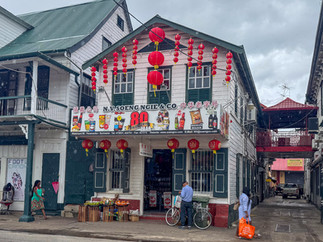
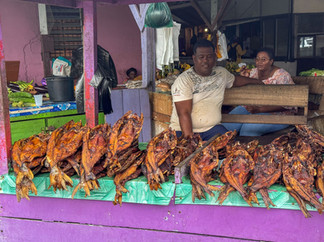
The small ferry carried us to Suriname and after having cleared immigration and customs we continued our way. There was not much traffic so it took us a while to realise that - despite having been a Dutch colony - traffic in Suriname drives on the left! The road soon lead us into Paramaribo where we installed ourselves in Nieuw Amsterdam, just outside the old fort. We explored the city, the market, saw countless shops that buy (illegally mined) gold and enjoyed really great Indian and Chinese food. Suriname’s population is a wide mix of different ethnicities with Indian being the biggest one. All over the country you see Hindu temples, mosques and churches, often just next to each other. While we heard of strong political rivalries between the groups, everyday life seems to be very different and everybody seems to come along quite well.



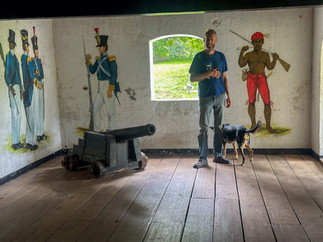


Suriname has one road leading south straight into the jungle but most of Suriname can only be reached using the many rivers that criss-cross the endless jungle. We took this road to its very end and looked at the option to continue further into the jungle by boat to any of the several lodges catering to the few tourists the country receives. The rather complicated logistics and the exorbitant prices scared us off however and we decided to enjoy more of the jungle in the Brazilian Amazon. Back at the coast a rather boring road leading through sugar cane fields and cattle farms and full of potholes brought us to the next border crossing at the Courantyne River, the border to Guyana.









We had spent the night at this idyllic spot in front of the ferry terminal. A reasonably sized queue formed early morning but as we had arrived the day before we were allowed to jump it. The exit procedures were quite rigorous as Suriname transmitted all information before hand to Guyana in order to avoid any potential refusals. A small and very slow ferry carried us over to Guyana where - since a long time - we got the taste of British bureaucracy. Filling in forms, copying redundant information and passing it on from serious looking officer to officer. After a while we made it out of the harbour and continued our way along the coast.


The rain was back and it took us quite a while to find a spot for the night as it was either very muddy or simply quite populated.
The coastline from the border to Georgetown is relatively short, just about 180 kilometres. Beyond that, there is no road along the coast, it is also the contested region of Essequibo (across the river of the same name) that is also claimed by Venezuela. The next day we already reached Georgetown where we were welcomed in a “government business park” with several small offices and lots of green and space relatively close to the center. This controlled area was to become our base for the next few days while we explored the small capital. We still had to get used again to these small countries after having spent so much time in the other huge South American countries.
There is not yet much to see of the economic boom created by the discovery of one of the largest oil fields on the planet. We assume that it will take a few more years until these incredible amounts of money will trickle down to the very small population, if they ever will. Billboards with advertising by ExxonMobil and road construction on the infamous Georgetown to Lethem road were the only signs we could find of the claimed investment boom.
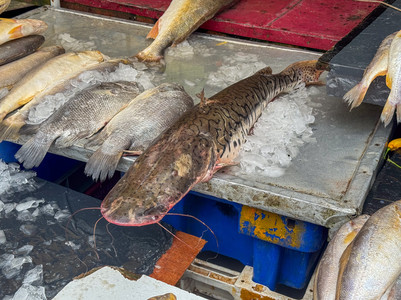
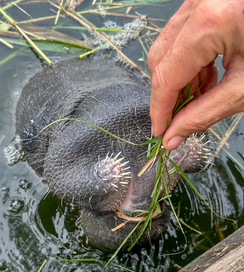
As in Suriname, Guyana has a sizeable Indian community. Originally imported as labour they make up about 40% of the population. The rest are of African origin, Amerindians and smaller groups of Chinese and Europeans. Again we enjoyed really great Indian food, strolled through the market, and tried to figure out the road condition on the road to Lethem, back to Brazil. To our surprise we stumbled on manatees in the city park, and lots of them. Somehow these “sea cows” made the ponds in the city park their home and love being fed fresh grass. We had tried to see a single one since Mexico but never saw more than their nostrils. Here in Georgetown they almost come out of the water when being fed and show their strange teeth and feet or flukes, quite a spectacle and we enjoyed it for hours.







The weather forecast announced a less rainy period and so we decided to embark on our last stretch through the Guyanas, the road to Lethem. This 550 kilometre stretch of mostly red mud through the largely virgin jungle is the only road back to Brazil and, depending on the weather, can be a real challenge, even to experienced overlanders. Having stocked up on Guyanese rum we left Georgetown. The first stretch is still paved, then starts a section with intense road construction which makes things worse as some parts are very soft and the potholes very deep. The rain set in as we passed the last camp for road workers and we decided to stop somewhere in an opening in the forest for the night. The next day continued in a similar way, deep potholes, lots of mud, one or the other local mini bus (typically Nissan Hilux) covered in red mud and very occasionally a Brazilian road train. You definitely slow down and leave them the road while they slide from left to right and back.
We briefly thought of a detour towards the famous Kaieteur Falls but the road conditions for it were extremely poor and it wasn’t even guaranteed that we would find a guide to hike to the falls from Mahdia. Late afternoon we reached the ferry crossing across the Essequibo and we decided to try our luck and find a place for the night in a local village along the river. Luckily we had read that it is advisable to ask the “Tuschau” for permission before entering an indigenous village. Tuschaus are the persons of authority and if a Tuschau gives his ok, the whole village will be ok. We stopped at the first house and asked for the Tuschau and were promptly sent towards the school. Some local kids guided us to the house of the Tuschau but no one was home, the local teacher was the next stop. He as well was very friendly and curious and after having explained our story and answered countless questions he called the Tuschau, a woman in that village and - after the teacher explained our story to her - she promptly gave her ok and suggested a flat spot by the river. Off we drove, it rained heavily, and the road got narrower and narrower. I decided to continue on foot and when I saw the mud field by the river I decided that we had to push back and find a safer spot. Poor visibility in the rain and a freshly dug conduct that I mistook for part of the road in my mirror ended our drive. Rouletout sank deep into the mud on the left side and the only way out was someone to pull us out. I hiked back to the school and explained our situation. Luckily we had the Tuschau’s blessing and she quickly ordered the local wheel loader to pull us out. Half an hour later we were parked on the flat and solid road, ready for the night.

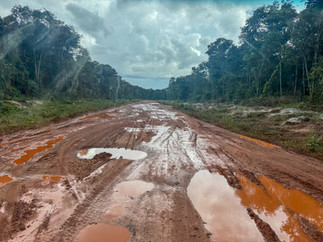



Day three started with nicer weather but the road was still very wet. The first few hours led us through pristine rain forest and the road became more hilly and twisted. After a couple of hours we suddenly reached the savannah and grassy plains replaced the dense jungle. The road also became harder, however long stretches were really bad washboard. We enjoyed the drier air and the views, passed through the occasional indigenous village and stopped for a last night not far from the road.
The last hours towards the border passed quickly. We stopped in Lethem, a dusty small town with lots of duty free shops for Brazilians, for shopping and soon crossed the border into Brazil. Just 360 kilometres on Brazilian territory were laying ahead of us on our way to Venezuela but first we had to stop in Boa Vista, the capital of the northernmost state of Brazil, Roraima. We needed a break after a lot of driving and Rouletout some love after long stretches of bad roads.
We decided to check in on a small fazenda that we had heard of and were welcomed there by the friendly host Alzir. Alzir helped us organising everything we needed: A specialist for Berna’s back that had also badly suffered on the roads, a decent truck wash to remove tons of red dirt from Rouletout, someone to weld our motorbike’s exhaust, someone to weld some parts on Rouletout, someone to exchange Reais into US$ for Venezuela… Of course we also explored the friendly town of Boa Vista, jumped in the nearby river to cool down and organised ourselves for our next adventure, our journey through Venezuela. But as always, more on that in our next blog post.


Comments